01
Historical methods, documented
Caesar, Vigenère, Atbash, monoalphabetic substitution, affine cipher, Polybius square… Each technique gets its own page explaining how it works, where it breaks, and how to attack it by hand.
New : Cipher Breaker, the codebreaking assistant, is now on Android Discover
Cryptography, played
CipherChronicle turns every grid into an investigation. You don’t attack the text: you take it apart step by step, until the hidden message surfaces.
Grid
Ciphertext
A block of letters that looks random.
Frequency analysis
The most frequent letters betray the source language.
Hypothesis: Caesar (+3)
The pattern suggests a regular alphabet shift.
Apply the inverse shift
Each letter moves back three positions.
Message revealed
The grid finally tells its story.
A CipherChronicle grid is not an opaque riddle: it’s a mechanism you disassemble. Each stage reveals a new rule and the grid shifts under your eyes.
01
Caesar, Vigenère, Atbash, monoalphabetic substitution, affine cipher, Polybius square… Each technique gets its own page explaining how it works, where it breaks, and how to attack it by hand.
02
No game server: generation, validation and solving all happen client-side. We store only the SHA-256 hash of the solution — never the cleartext.
03
Build your own grids in a few clicks, publish them under your handle, and track your progress on the community’s puzzles.
Stuck? The hint staircase reaches out, step by step. You pick how far you go — no spoiler crashes the party uninvited.
Your solution never leaves the browser. We compare a fingerprint, never the text — even we don’t know what you guessed.
Once the grid falls, dive into the page: who dreamed the method up, in what context, and how it eventually cracked. Crypto is also good storytelling.
New · Android
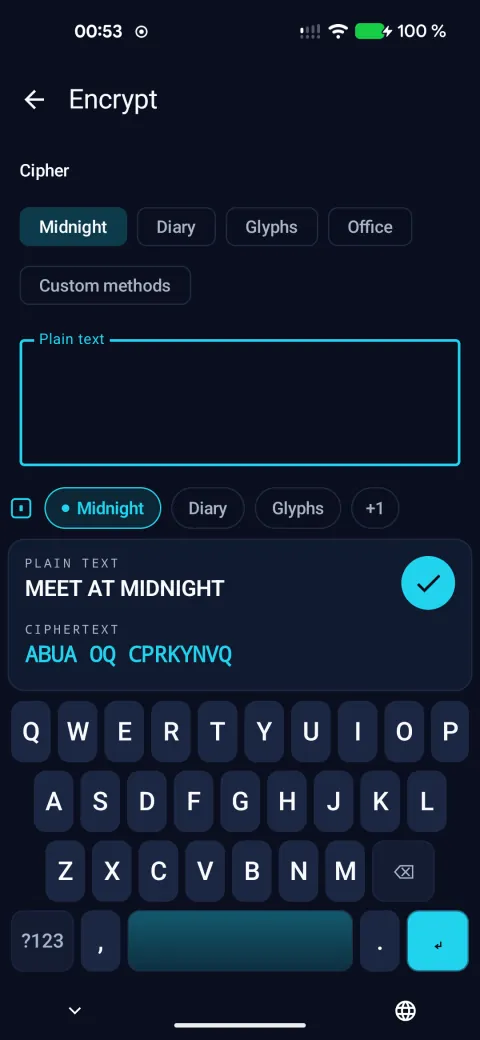
The Cipher Chronicle Android app encrypts as you type, in any messaging app. Build your own cipher: no account, no Internet connection.
A living directory of classic techniques. Every method has its own page with history, example, weaknesses and related puzzles.
caesar
A fixed alphabet shift. The classic — easy to grasp, easy to break.
rot-13
A special case of Caesar (shift 13, involutive).
atbash
A full alphabet flip. A ↔ Z, B ↔ Y.
vigenere
A Caesar whose key changes at every letter. Long thought unbreakable.
rot
The mother family of shift ciphers: ROT-N for any integer N. ROT-13 and ROT-47 are the iconic ones.
substitution
A free permutation of the alphabet. 26! options — but frequency gives it up.
Identify by symbol
Got glyphs but don't know which cipher? Compare them visually.
Universes
Star Wars, Gravity Falls, Skyrim, Egyptian hieroglyphs, Renaissance occult alphabets, Second World War rotor machines… Pick whichever universe speaks to you — we sorted out the rest.
11 universes · 164 methods
Caesar, Vigenère, Atbash, Enigma: the ciphers that shaped cryptography from Antiquity to the Second World War.
No substitution — the letters move. Scytale, turning grille, rail fence, double transposition: geometry in the service of secrecy.
Hieroglyphs, ogham, Tifinagh, runes, Morse, semaphore, braille: writing systems that actually existed.
Theban, Malachim, Enochian, the celestial alphabet, Pigpen: the magical alphabets passed down through medieval and Renaissance grimoires.
Use cases
A few real-world examples of people bending CipherChronicle to craft unforgettable moments.
Have your guests crack a puzzle during the cocktail or to reveal the seating chart.
Turn a guided tour into a city-wide encrypted treasure hunt.
Layer historical cryptography on top of your trickiest puzzles.
Get students working on historical ciphers — a lively gateway to math, history and logic.
The questions we hear the most about how the site works and how your data is handled.
See all questionsIn English both « encrypt » and « encipher » are accepted, but the distinction matters: strictly, you encipher with a key and decipher with the key, while « decrypt » means recovering the plaintext WITHOUT the key — breaking a cipher. French draws an even stricter line: « chiffrer » (to cipher) is correct, « crypter » is flagged as incorrect by the French national security agency (ANSSI) and isn’t recognized by the Académie française. Throughout the site we use the precise terminology.
No. We only keep a SHA-256 hash of your solution, computed client-side. Nobody — not even us — can recover the cleartext from that hash.
Not for public grids. An account is only required to create your own puzzles and to track your progress.
Yes — the “Encrypt” page walks you through it. Pick a method, a source text, a difficulty, then publish.
Warm up on an easy grid, or jump straight into crafting your first cipher.
We use Google Analytics to understand how the site is used. No personal data is collected. You can accept, reject, or change your choice later from the footer.